

About the module
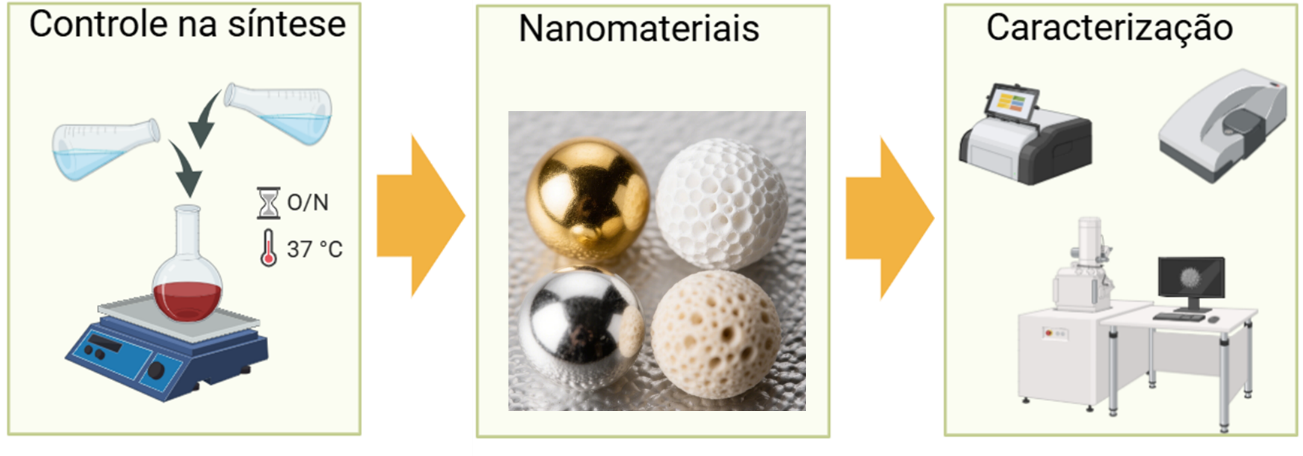
Nanotechnology studies materials with dimensions between 1 and 100 nm and supports applications ranging from photonics to medicine. Current chemical methods enable the production of different classes of materials with strong control over final characteristics such as morphology, size and composition.
Syllabus
- Theory of nanotechnology: history, development, current state, applications and challenges. Selection of materials.
- Material synthesis and preparation of written and oral presentations.
- Material characterization, data processing and organization of results.
- Surface modification of one selected material followed by characterization.
- Integrated discussion of results and preparation of the final presentation.
Prerequisites
No prerequisites.
Bibliography
- N. Baig, I. Kammakakam & W. Falath, Materials Advances 2, 1821 (2021).
- E. M. Björk, Journal of Chemical Education 94, 91 (2017).
- K. Phiwdang et al., Energy Procedia 34, 740 (2013).
- J. N. Hasnidawani et al., Procedia Chemistry 19, 211 (2016).
- A. M. Chiriac et al., Applied Surface Science (2025), 163759.
- H. M. Chenari et al., Materials Research 19, 1319 (2016).
- N. G. Bastús, J. Comenge & V. Puntes, Langmuir 27, 11098 (2011).
- L. Vigderman & E. R. Zubarev, Chemistry of Materials 25, 1450 (2013).