

About the module
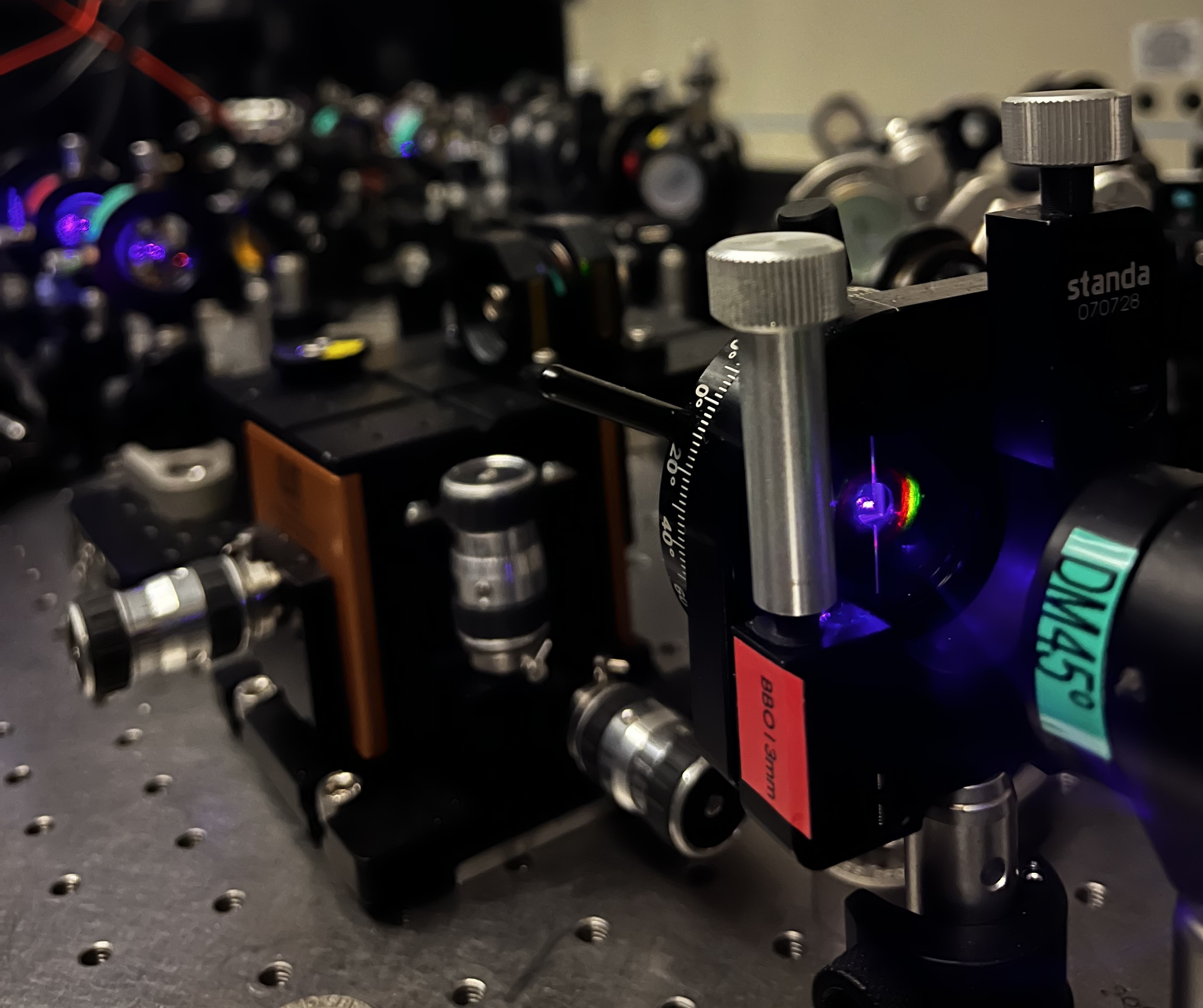
How can a nonlinear crystal amplify light, generate entangled photon pairs for quantum communication, or produce squeezed states for quantum sensing and quantum computing? This module presents optical parametric amplification (OPA) as a bridge between nonlinear optics and quantum optics. Starting from three-wave mixing and second-order nonlinear processes, the course covers the classical description of OPA, spontaneous parametric down-conversion (SPDC), photon-pair generation, and squeezed light. The theoretical classes are integrated with experimental activities at the CBPF Quantum Tech Lab, where students will participate in the alignment, generation, and characterization of an entangled photon-pair source.
Syllabus
- Nonlinear optics and three-wave mixing: nonlinear polarization, second-order susceptibility χ(2), sum- and difference-frequency generation, and the fundamentals of parametric amplification. Experimental activity: alignment of optical systems and coupling of light into optical fibres.
- Classical optical parametric amplification: coupled-wave equations, phase matching, parametric gain, and differences between continuous-wave and pulsed lasers. Experimental activity: assembly of the photon-pair generation system.
- Introduction to quantum optics: quantization of the electromagnetic field, interaction Hamiltonian, vacuum state, Fock states, and squeezed states. Experimental activity: continued assembly and alignment of the source.
- Low-gain OPA and SPDC: photon-pair generation, energy and momentum conservation, phase matching, and signal–idler correlations. Experimental activity: source engineering for entanglement generation.
- SPDC as a quantum-light source: heralded photon generation, coincidence measurements, second-order correlation function g(2), entanglement, source brightness, collection efficiency, and filtering.
- High-gain OPA and squeezed light: Bogoliubov transformations, quadrature operators, squeezed vacuum, two-mode squeezing, and the connection between SPDC and high-gain OPA.
- Applications of quantum light in quantum communication, quantum computing, and quantum sensing. Experimental activity: implementation of an entanglement-based quantum communication protocol.
- Experimental integration: final alignment and characterization of the SPDC system and analysis of the quantum communication protocol.
Prerequisites
A background in quantum mechanics is recommended.
Bibliography
- Kalash, M.; Sudharsanam, A.; Passos, M. H. M. et al. Real-time monitoring of multimode squeezing. Nature Communications 17, 3904 (2026).
- Asavanant, W. et al. Generation of time-domain-multiplexed two-dimensional cluster state. Science 366, 373–376 (2019).
- Yin, J. et al. Satellite-based entanglement distribution over 1200 kilometers. Science 356, 1140–1144 (2017).
- Brida, G.; Genovese, M.; Ruo-Berchera, I. Experimental realization of sub-shot-noise quantum imaging. Nature Photonics 4, 227–230 (2010).
- Akatev, D.; Meng, Y.; Brewer, J. et al. Broadly tunable quantum-enhanced Raman microscopy for advancing bioimaging. Optica Quantum 4, 108–113 (2026).
- Boyd, R. W. Nonlinear Optics. 2nd ed. Elsevier, 2002.
- Mandel, L.; Wolf, E. Optical Coherence and Quantum Optics. Cambridge University Press, 2013.