About the module
Exploring the subatomic universe requires sophisticated detection technologies, acquisition systems and large data sets. The module covers particle-detector theory and practice, from radiation–matter interactions to current techniques used at accelerators and in cosmic-ray studies.
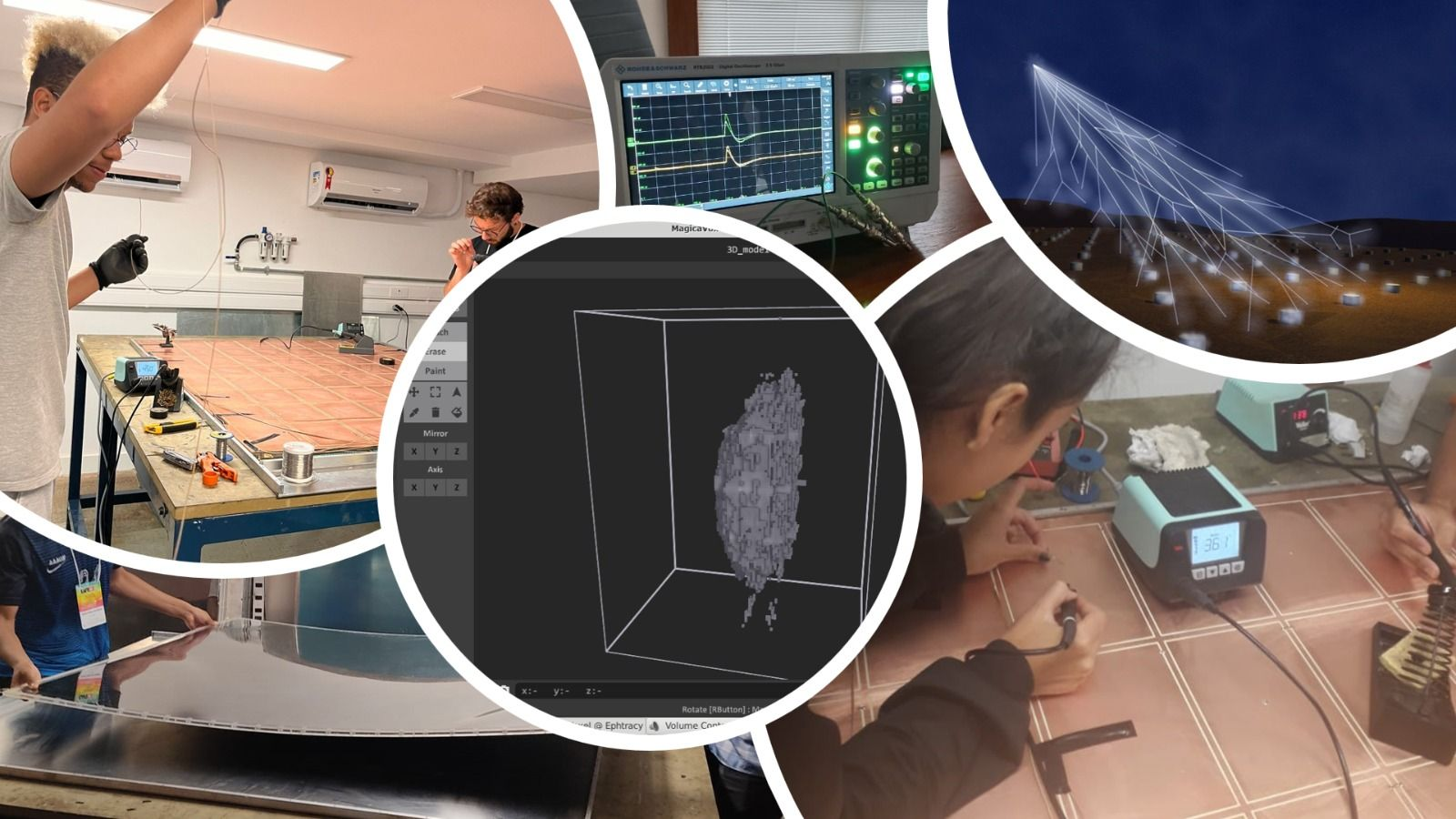
Participants will perform coincidence and energy measurements with a water-Cherenkov detector, track muons with RPC detectors and SiPM-coupled scintillators, build a cosmic-ray detector and develop a small FPGA-based embedded system. Geant4 and ROOT will be used for simulation and data analysis.
Syllabus
- Radiation–matter interactions and operating principles of high-energy-physics detectors.
- Electronics for data acquisition and signal processing.
- Verilog programming for FPGA.
- Simulation and data-analysis software, including Geant4 and ROOT.
- Assembly and calibration of RPC detectors and SiPM-coupled scintillators.
- Data collection and analysis for muon flux, direction and angular distribution.
Prerequisites
Students in the second half of undergraduate Physics or Engineering programmes, as well as graduate students interested in the subject.
Bibliography
- K. Grupen & B. Schwartz, Particle Detectors.
- M. Thomson, Modern Particle Physics.
- S. Palnitkar, Verilog HDL.
- Material produzido pelos professores do módulo.